
What Happens When Employers Lead
Five years of Hire Local DC show what’s possible when industry takes shared ownership of workforce challenges
When DC’s construction leaders first came together in 2021 to talk about workforce challenges, they were all dealing with the same problem: companies were hiring and good jobs¹ were available, yet too few DC residents were filling them.
Each employer was trying to solve the issue independently. They were building relationships with education & training providers, experimenting with hiring strategies, and investing significant time and resources into local recruitment efforts. But this siloed effort made it difficult to comprehensively address talent demands.
As Paul Choquette, Regional President of Gilbane Building Company and a founding leader of DC Builds DC, put it:
“Before DC Builds DC started, you had all of these construction companies trying on our own to figure out our local workforce challenges. There was a lot of effort, but at the end of the day, it wasn’t working. Whenever I drove to job sites, the parking lots were filled with cars with license plates from states that are far away.”
Recognizing that no single company could solve the challenge alone, Choquette joined Linda Rabbitt of rand* construction corporation, Jay Grauberger of Clark Construction, and Neil Stablow of Donohoe Construction Company to partner with CityWorks DC and the Federal City Council on a new approach: bringing employers together to tackle workforce challenges collectively rather than individually.
That decision led to the launch of Hire Local DC, a collaboration between CityWorks DC and the Federal City Council designed to help local industries more confidently rely on local talent to meet workforce needs.
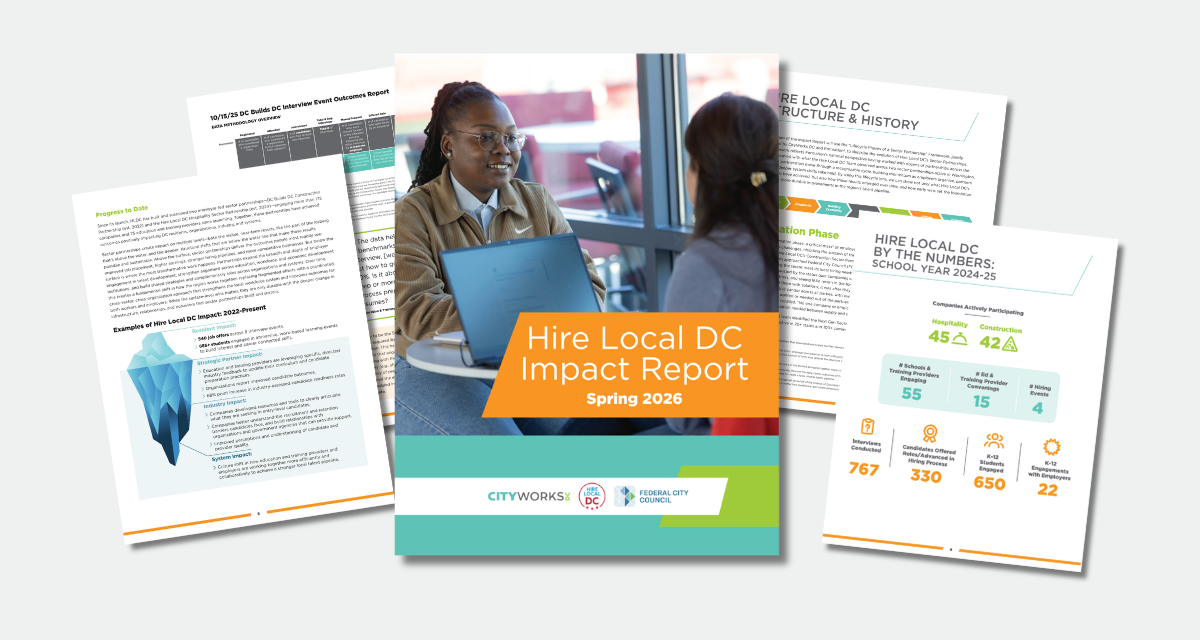
Today, we’re releasing Hire Local DC’s first Impact Report, reflecting on the initiative’s first five years of work with DC’s construction and hospitality sectors.
The report captures what we’ve learned, the progress that has been made, and what it takes to build stronger local talent pipelines that work for employers and DC residents alike.
Employer Leadership Changes Systems
One of the clearest findings from this work is that workforce systems function differently when employers move from only being advisors to serving as collaborative co-designers.
Too often, employers are invited into workforce conversations after key decisions have already been made. They are asked to react to pre-baked solutions rather than shape the design of the talent pipeline itself and share ownership of the results.
Hire Local DC has taken a different approach: employers set priorities for the talent pipeline; align education and training providers, government agencies, and workforce partners; and hold themselves and partners accountable for results.
That shift has produced measurable results. Over the past five years, Hire Local DC has:
Engaged 87 companies
Partnered with 55 education and training providers
Conducted 1,247 interviews across eight hiring events
Helped 540 candidates receive offers or advance in hiring processes
Connected over 885 high school students and families to industry-led career exploration opportunities
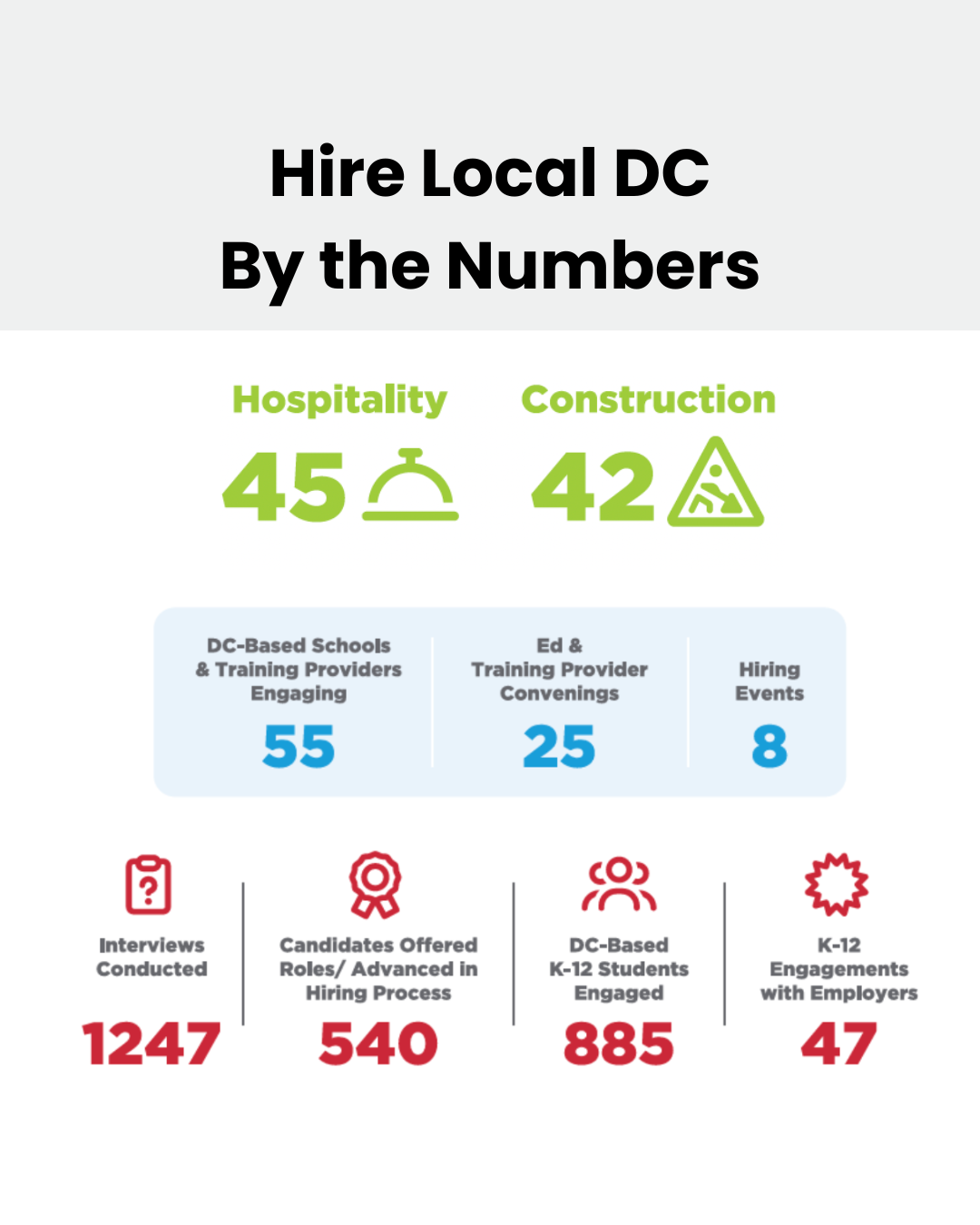
But the most important changes are happening beneath the surface, in how employers, providers, and public systems are working differently because of this partnership.
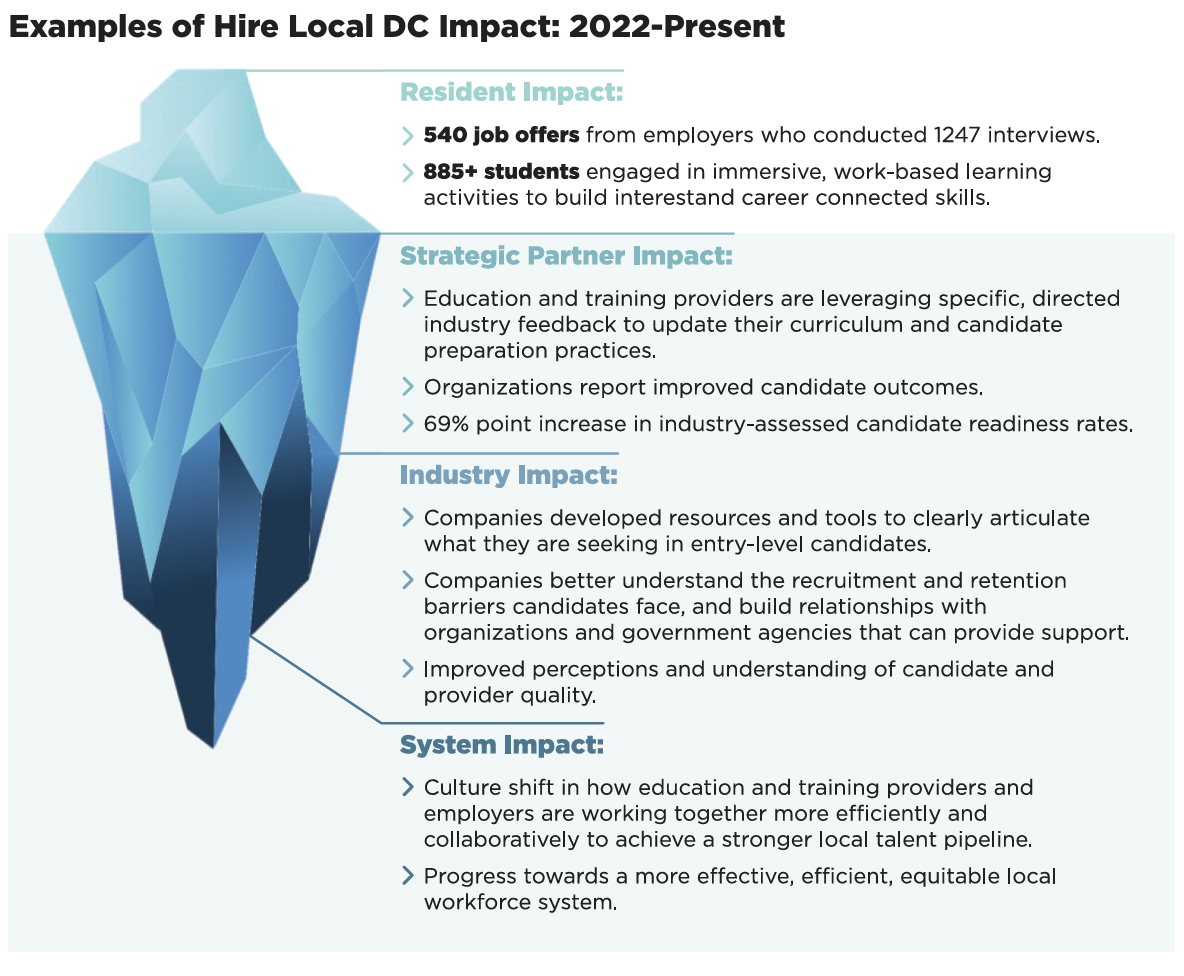
Graphic of Hire Local DC’s Impact from the Report
Better Feedback Leads to Better Outcomes
One of the earliest lessons came during Hire Local DC’s first hospitality hiring efforts in summer 2022. Hospitality leaders approached Hire Local DC to help address urgent post-pandemic hiring needs. Employers assumed providers were preparing candidates for exactly what hiring managers were looking for, and providers assumed the same. But the first hiring event revealed otherwise: only 5 percent of the first 200 candidates were assessed by employers as job-ready.
That gap was difficult, but it was also clarifying. As Thomas Penny, President of Donohoe Hospitality and a founding leader of the Hire Local DC Hospitality Sector Partnership, reflected:
“We assumed that the education and training providers and the industry’s hiring managers were on the same page about what a job-ready candidate meant. But we found only 5% of the first 200 candidates were assessed by industry as job ready. We realized that we needed to make it really clear to those training the talent what we were looking for.”
This failing result caused employers to define job-readiness expectations and share them directly with education & training providers. The insights about job-readiness from employers was gold. Providers immediately integrated that information into curriculum and candidate preparation. Then, candidate readiness rates quickly climbed.
“Now we routinely see 70%+ of candidates coming to our hiring events job ready,” Penny said, “a dramatic improvement that sets us all up for greater success.”
This rapid improvement is possible when feedback moves quickly and clearly across the system. It sounds straightforward, but in practice, it is rare.
Employer Ownership Versus Attendance
Another takeaway from the report is that meaningful employer leadership requires real ownership of talent recruitment processes.
Dominic Argenieri, President of Davis Construction, describes what that has looked like inside his company:
“Once we learned about DC Builds DC, we were totally on board. I joined the Federal City Council and am on the DC Builds DC Leadership Team. Our Senior Vice President co-chairs the DC Builds DC K-12 Action Team. Our Talent Acquisition Manager attends all of the Hiring Events, at which we’ve gotten some great new hires. Our head of Learning took the lead on developing resources for industry guest speakers to use when visiting partner high schools.”
His conclusion captures what many employers have experienced:
“We’re giving a lot, but we’re getting even more out of the partnership.”
That kind of engagement is what allows this work to move beyond one-off initiatives and into real systems change.
The Impact on DC
DC’s workforce challenges are not about a lack of talent or a lack of opportunity, but about coordination across the local talent pipeline.
When employers and providers work in isolation, providers don’t have timely industry feedback, employers don’t get prepared candidates, and the larger system lacks shared visibility into what is working and what isn’t. Even strong individual efforts struggle to produce strong collective outcomes.
Hire Local DC was built to change that. As Antwanye Ford, Chair of Hire Local DC and CEO of Enlightened Inc., puts it:
“We are making it easier for companies to hire local. We are making it easier for our schools and training programs and universities to work with industry. And because of that, we are making it easier for DC residents to navigate this complex job market and find and succeed in good jobs.”
The report makes clear that stronger local talent pipelines require employer leadership, coordinated support across education and workforce systems, and continuous feedback loops that allow everyone to adapt. Five years in, we are seeing what becomes possible when those conditions are in place.
We hope that the Hire Local DC Impact Report is a valuable resource not only for DC organizations seeking to understand what has worked in the District, but also for organizations nationwide looking to implement workforce initiatives that strengthen their communities. Please share your thoughts and reactions!
¹ A good job is a full-time role which 1) is in a high-demand, high-growth sector, 2) provides opportunities for skills and career advancement, and 3) provides a living wage that provides family-sustaining income and benefits.